
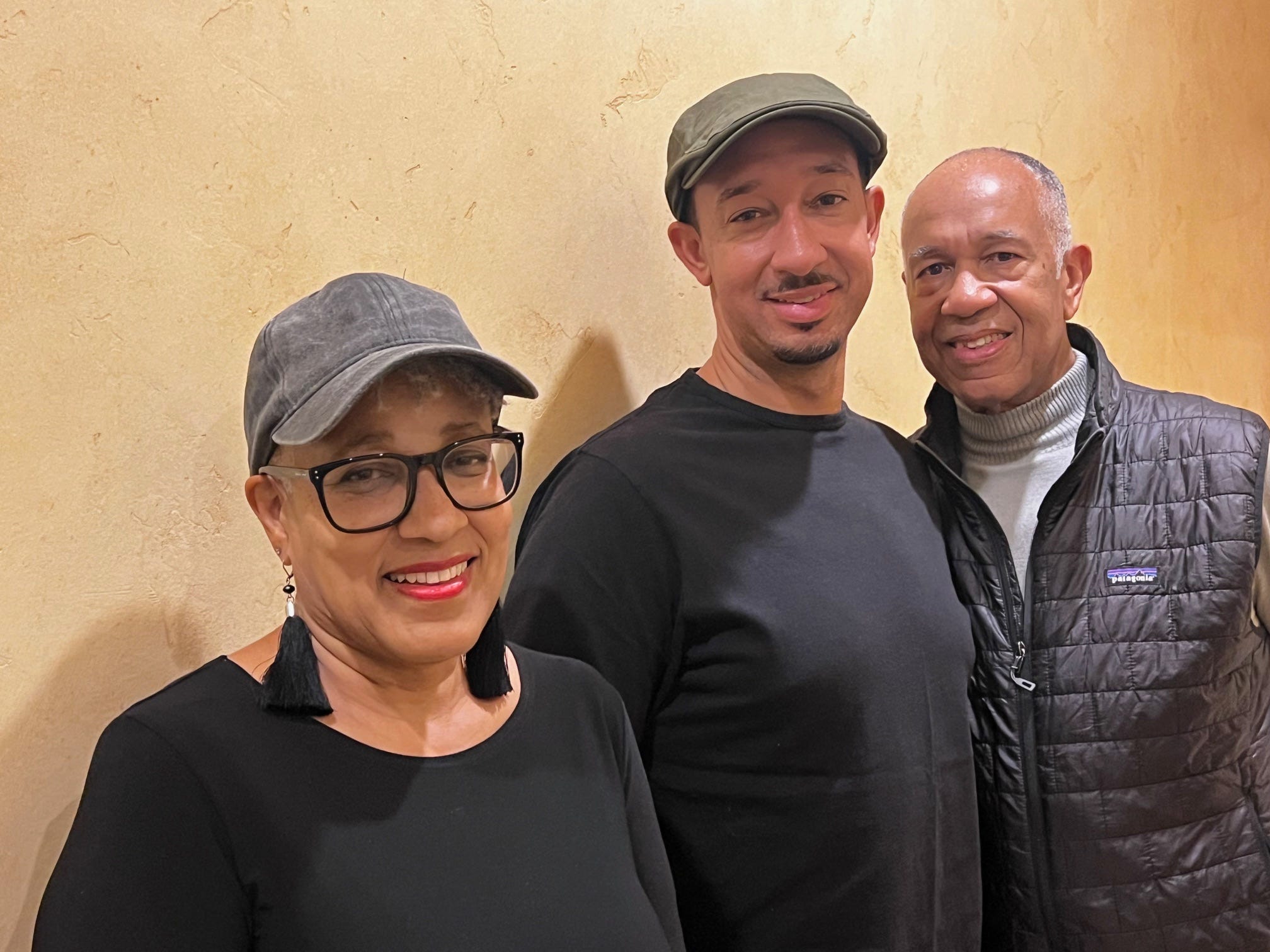
Photo of Rene Marie, Gerald Clayton and John Clayton by David Harper
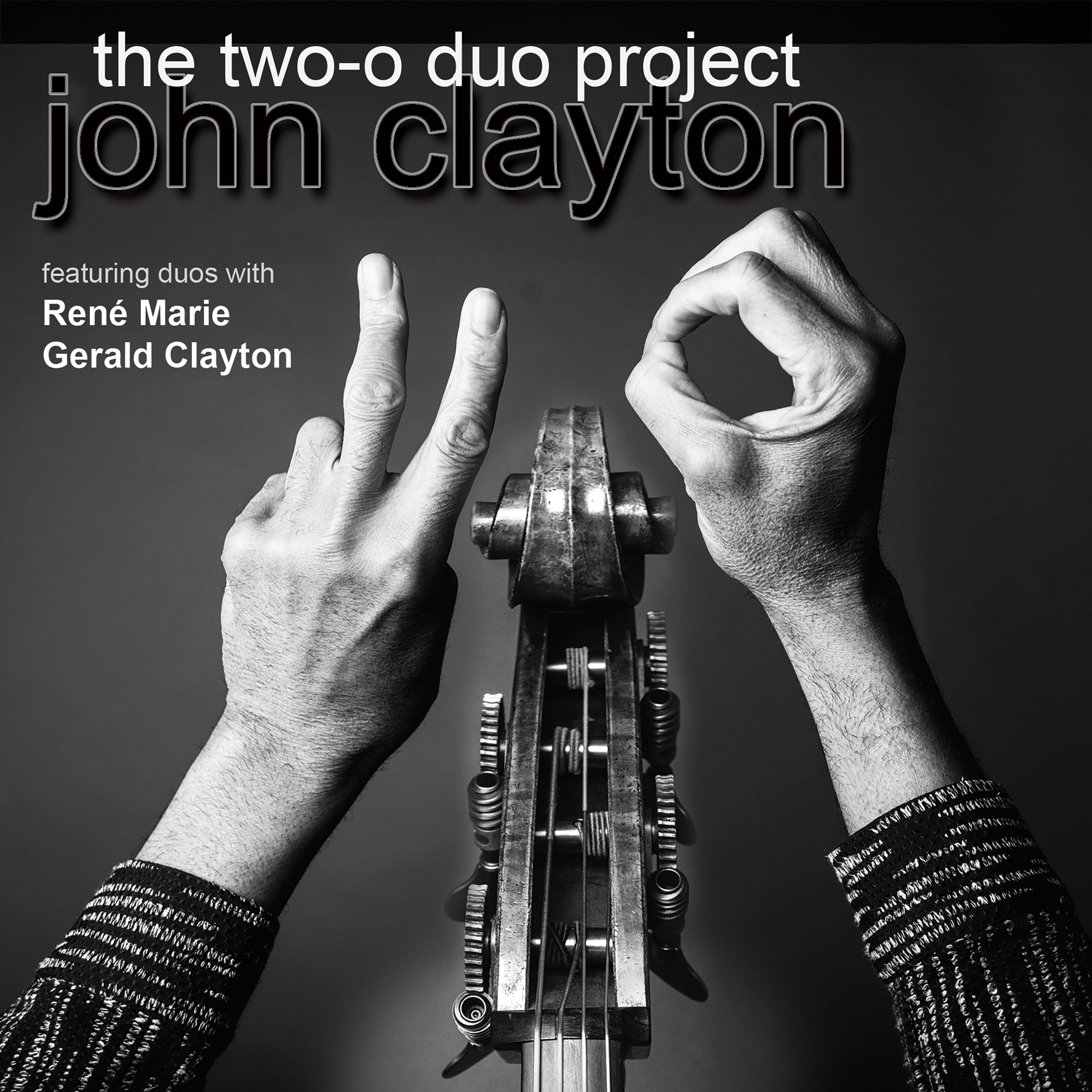
John Clayton admits that the title of his new album, Two-O Duo, is a bit of a misnomer, because in addition to duet tracks with his son Gerald and the singer-songwriter Rene Marie, there are some tracks on which all three perform. “It was a chance for me to play duos with two people that are special to me,” he explains. “And since we’re just hanging out in the same place, why not throw in some trios?” He added that he just couldn’t seem to add “Trios” in the title without it being a tongue-tying word salad.
Released on ArtistShare under its unique crowdfunding and revenue-sharing model, Two-O Duo features a diverse repertoire ranging from jazz standards such as 70s-80s rock tunes to original compositions from Gerald and Rene. In several cases, such as “Somewhere Over the Rainbow” (with Rene) or “Nail…In Need” (with Gerald), the performance is a stripped-down duet, while on cuts like “Come Sunday,” all three record together. Throughout the recording, the sympatico feel in unmistakable, which is no surprise given the three’s past work together. Gerald has spent a lifetime playing with his father, including a longtime stint as the pianist in the Clayton Brothers band. The Virginia native Rene was the lead vocalist for Gerald’s ambitious large-scale work, The Piedmont Blues. Finally, John has performed with Rene numerous times over the years.
John spoke with me about the origin and evolution of the project, as well as about the unique gifts of his collaborators.
Lee Mergner: First of all, I object to the title. Duos and Trios is more like it. But seriously, what brought you to bring these two important people in your life together for this recording?
John Clayton: It’s about the focus. It’s very selfish. It was a chance for me to play duos with two people that are special to me. And since we’re just hanging out in the same place, why not throw in some trios?
Did it start with just doing a duet recording with Gerald?
It was much more intentional than that. It started with me saying to Gerald, “Hey, don’t you think it’s time we do another father-son duo record?” Because it’s been a while. He said, “Well, I’ve got this contract with Blue Note now. And I said, “OK, cool. I get it. No problem.” That got me thinking, because we love playing together, but that frame wasn’t going to work.
So I started thinking, “What can I do?” Then I thought, “How about an album of some duos? And what would I do for the rest?” And I thought, well, let’s keep it duos, basically, essentially. And that opens the door for any sorts of duos. I just thought about Rene, and I thought, “Man, I love what she does.” In the event that Gerald and she want to do some things together, that’s also possible, because they’ve worked together, particularly on Gerald’s Piedmont Blues project. That’s how it all started, just the focus on Gerald and me, and then how we were going to expand that to do duos with somebody else as well.
I love the vocal and bass duo format. I was thinking about Sheila Jordan’s duo recordings and performances with Harvie S. But I can’t think of many other projects like that. It really does require a special vocalist.
You’re absolutely right. There have been things that bass players have led that focused on their relationship. I’m thinking about Ray Brown and his Some of My Best Friends Are…Singers album. But it’s hard to find a whole album project of just bass and voice.
I have to say that Rene really stands alone as a singer-songwriter in our world of jazz. I just really can’t think of too many vocalists who bring that same sheer breadth and creativity as composers.
I think about my favorite singers, and there are a lot of them, and one of the common denominators is that they always include some kind of dramatic element. I don’t mean that in a Hollywood way. But they just make the message of the music and the experience come alive in that way. Carmen McRae, when I worked with her, forced you to listen to the meaning of a song. She would sing, “Someday he’ll come along, the man I love.” Then she’d go, “And he’d be big and strong.” Then when she’d sing it that second time, it was just so tender. She forced me to listen to the meaning of lyrics. That’s one thing I love about the singers that really draw me in.
Right, there are some singers who come out and it feels like they own the stage somehow. It’s what they say about certain actors in either a play or a movie, where people just can’t not look at them.
I love it when they can draw me into their space, because I’m a clean slate whenever I hear somebody. I’m just, “Okay, what you got?” But somebody who is less dramatic, if you will, but still draws me into her space is Diana Krall.
That’s interesting because, on the surface, she almost has the opposite of that dominating presence.
Exactly. But if I allow myself, she’ll be in that sort of introverted and reflective mood where she’s almost whispering, talking to herself. And I’m there. I get caught up in it.
The repertoire is really interesting. Rene has such a broad appreciation for tunes and is not afraid to sing a rock or folk tune that no jazz person would think of doing. She has a real feel for 70s singer songwriters. How’d you take to doing tunes by Carole King and Billy Joel?
It’s basically an extension of my mindset, because when I grew up, there wasn’t jazz in my house. There was Motown and my mom playing gospel piano. That was my upbringing. I discovered jazz through the high school jazz band. I’d never heard that stuff before. That’s how I got into it. So what Rene does in terms of her repertoire is not far afield from me, because the more I got into music, the more I was drawn into listening to and having to play those 70s tunes. That’s the stuff that I grew up on.
Also with Rene, it’s always about the message. If the message doesn’t connect with her, which I absolutely respect, then she’s not going to do the song. She’s going to first be drawn by that, and then she’ll figure out how she can shape it and bend it and mold it into something that’s cool. I love her approach.
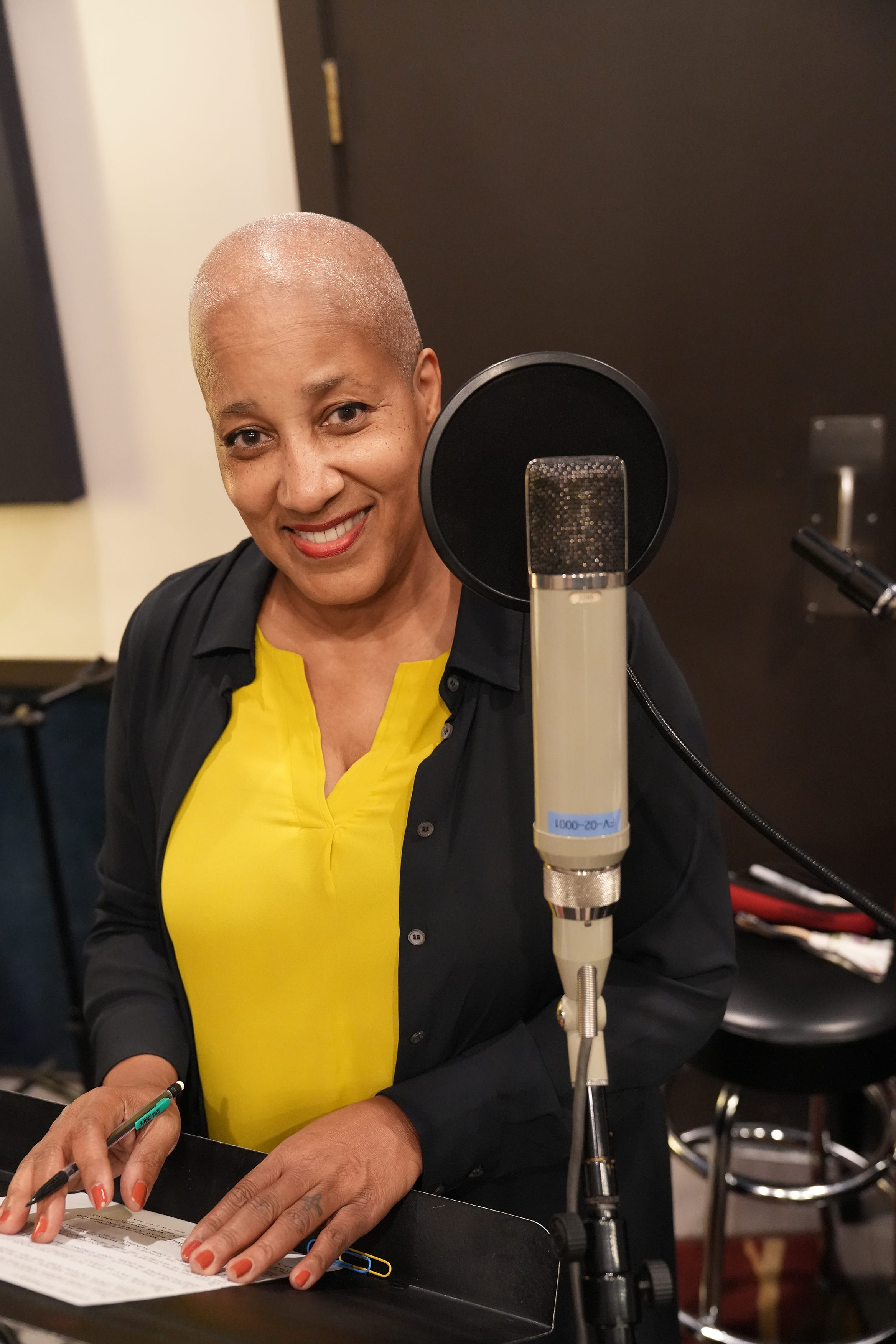
Photo of Rene Marie by David Harper
I found that myself with that Billy Joel tune “The Longest Time.” His version was an upbeat doo wop thing. But when Rene did it, you could hear and feel that it was about being in a long relationship with someone and losing that magic that you have when you initially fall in love. You really hear the message because of the way she delivers it.
I love that about music. You can do such magical things with it, but the magic doesn’t have to be the same trick with the rabbit in the hat. You can find other things to do with it, even though it’s still the rabbit in the hat.
I love that you did “Come Sunday” with her, which originally was part of Duke Ellington’s Black, Brown, and Beige master work. It was one of the few parts of that large piece that had a second life.
A lot of that work, which is an amazing work, I think was molded and shaped to fit what the band was about. Versus, “Hey, here’s a work that is comprised of a whole bunch of Duke Ellington tunes.” This composition happens to be one that was easily extracted from the larger work and was relatable to so many people.
That’s an important song for me. I was talking to Benny Carter once, and he told me that one of the things that they had to do back in the early days when he was writing was sometimes write a big band arrangement with no score. They had to just write a whole big band arrangement and just write the first trumpet part and then put that aside. Take out more music, write the second trumpet part, put that aside, and do the whole band like that, never seeing how all the notes lined up in relation to each other.
You had to have that arrangement so clearly in your head that I said, “Damn, how do you do that?” I couldn’t imagine having an arrangement in my head that I could just write the third trombone part separately and the second tenor part separately. If you’re hungry and you’re curious, when you hear stories like that, you have got to try it. Snooky Young used to play “Come Sunday,” and I said to him, “Can I do a big band arrangement of this for you and our band, Clayton Hamilton Jazz Orchestra?” And he said, “Sure.” I thought, now’s my chance. I wrote that arrangement exactly how Benny Carter had instructed me, if you will. I did the whole thing with no score.
So “Come Sunday” is important to me on many levels, also as an arranger. It was a wonderful learning experience, and we actually recorded it with the big band. But I don’t think I’ll do it again.
No reason to climb Mount Everest twice.
That’s right. One and done, baby.
What do you think you have learned from Ellington as a big band arranger?
First of all, in the beginning, I did not understand why people were so excited about Duke Ellington. I was a teenager and I said, “Gosh, it sounds sloppy, and it sounds out of tune. Why is everybody excited about this guy?” Then I got it, and it changed my life. I think one of the things that really opened my ears was his album, 70th Birthday Concert. I heard all the songs on there. “Rockin’ in Rhythm” was the first one. Man, I absolutely got it. I understood the excitement. I understood the way they were swinging, which was a different way, if you will, than say Basie or Fletcher Henderson or you name it. It had something else that was inexplicable. You couldn’t define it.
Sometimes it seems to me there’s a certain propulsive quality to his arrangements.
It’s sort of driving. But you’ve got to absolutely put Count Basie in that same category. But you’re right. There was an Ellington drive. Also, I learned from Duke Ellington to expand my concept of intonation. When we hear something that we now define as out of tune, we think “Oh, God, he didn’t quite make that note.” Or “Gosh, there’s a rub there.” Duke Ellington, as you and many people know, wrote for the musicians in the group. He didn’t write just generic sax parts and trumpet parts. As a result, you’re writing for each person’s voice. And each person’s voice has attached to it their intonation. When you bring them together, now you’ve got a family of voices and personalities. Their intonation as an ensemble creates its own definition. And that’s what I learned.
I do the same thing. When I write for the Clayton Hamilton Jazz Orchestra, I don’t write for an instrument. I write for all those guys. As a result, our intonation is not something that you’re going to get by pressing a space bar on a computer in a music software program. It’s going to be Rickey Woodard, combined with Ira Nepus, combined with Bijon Watson, combined with Jeff Hamilton, combined with whoever. That was one of the biggest lessons I learned from Duke Ellington.
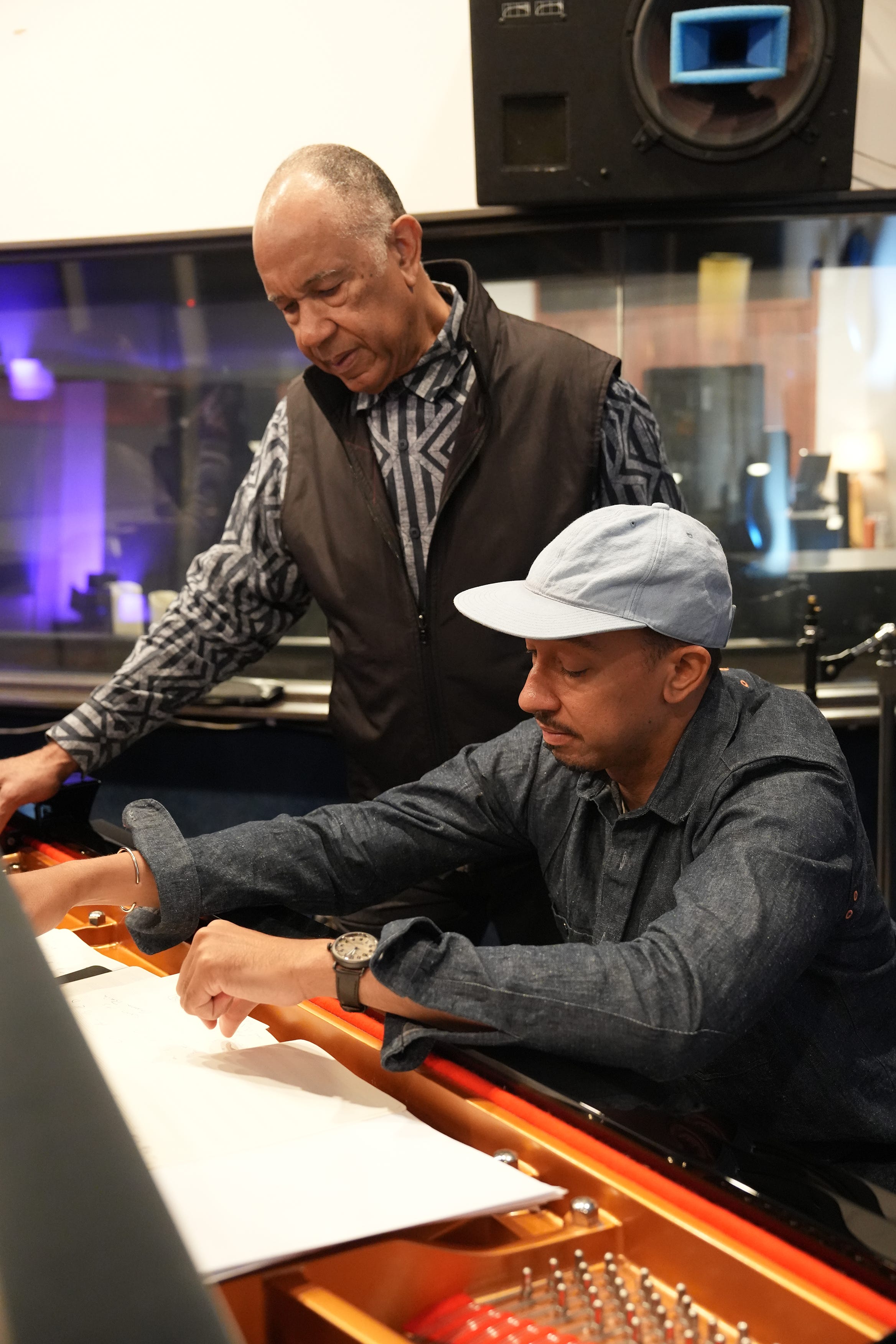
Photo of John Clayton and Gerald Clayton by David Harper
If it’s possible for you to be objective about it, how have you seen Gerald evolve as a pianist and composer?
I think it’s just been a constant expansion of how he was as a toddler. I often will point out to people that when he was playing in the sandbox, he must have been two or three years old, a bird would alight in a tree and just start doing a bird song. Without missing a beat, he started imitating the bird while he’s still playing in the sandbox. Then, a minute later, while he’s doing that, the ice cream truck comes by. He starts imitating the ice cream truck. He’s always been this guy who just hears sounds and absorbs them and then finds a way of regurgitating them.
That’s what I hear when I hear his music and when I look at the evolution of the early days compared to where he is now with his writing and with his playing. When he was a teenager, he’d go to school, come home, and he’d do something on the piano, and I’d think, “Damn, where did he get that from?” I mean, I’ve been there all along, and I have been paying attention to his resources, but where did that come from? Now, I’m not surprised when I hear something that is jaw-dropping to me because it’s clear to me that he’s been absorbing something that ends up blending into what he does and making it a part of his expression.
Are you going to be doing any live shows with either or both of them?
We do have plans to do things together. It’s just a question of finding dates that work for all of us. All three of us are into it.
The album is really well recorded. What have you learned about recording yourself and your groups from all your time in the studio?
I’ve learned some technical things that make it easier for me to be more or less assured that I’m going to get my sound right. In the early days, being the bass player who’s always in the middle and trying to please and make everybody happy, I allowed people to put a microphone on my amplifier. Or I allowed them to record me direct, meaning the pickup amplification device that is on the instrument would have a cord going from it to a box that goes to the engineer’s board. The problem with that you don’t get a true acoustic bass sound. They like it because they have more control over the bass and they don’t have to worry about the trumpet player playing so loud that his sound goes in the bass mic. They don’t have to worry about leakage if they do it that way. But it compromises the sound, because all acoustic instruments, including the voice, push air. And that air is not just something that we feel. We actually hear it. There’s an album that I did that was a big event for me and Jeff Hamilton playing with Monty Alexander at the Montreux Jazz Festival.
The Big Hair Trio!
That’s the one. I allowed them to just put a mic in front of my amplifier and they may have even taken me direct. To this day, I can’t listen to that album because of that. As a result of that I never have allowed people to take me direct again. There’s always a mic in front of the bass. After that all the records I made with Monty always had my bass sound. And the records with Count Basie, whether it was live or in the studio, there was a mic on the bass.
That’s number one with the studio experience when I record. I only allow mic on my bass. Now if the engineer in the studio wants to use a mic close to my fingers as well as another mic closer to the bottom of the instrument, I’m cool. That’s the biggest thing for me in terms of what I’ve learned to help me get more a more consistent sound that’s mine.
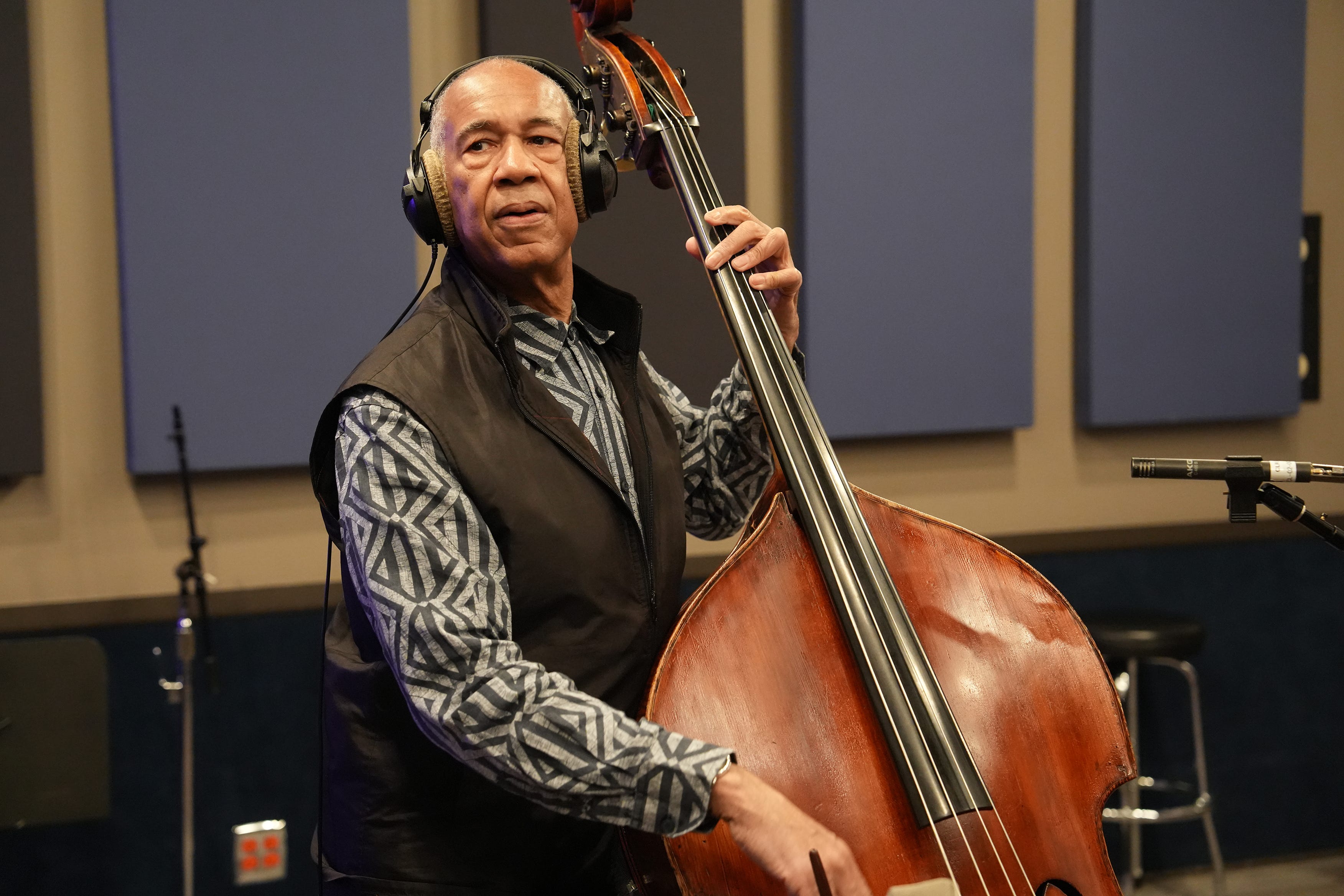
Photo of John Clayton by David Harper
Then you also learn other things, like where to place yourself physically to help the recording, but usually the engineers are savvy about that. So I don’t even think about that stuff anymore.
But of course they know the room too.
That’s right. The guy that recorded this album was Joel Moss, who unfortunately passed away. That was the last project that I did with him. He did nearly all of the Clayton Brothers albums and he did some of the Clayton Hamilton Jazz Orchestra recordings as well as some other projects. We were like brothers. So this album has a deeper meaning to me than other albums not only because of Gerald and Rene, but also what it represents with Joel.
Talk about ArtistShare and what that’s been like for you. It famously has a very different model than the usual record label.
Two things. Number one, it’s about something that I completely get behind and that is about sharing with people that are interested in experiencing the artistic process That’s stuff I normally don’t get to share. Normally I have to work on the album, clarify my thoughts, record it and put it out. I hope the people enjoy it, but it kind of ends there. Versus saying to the listener: “Hey, if you’re interested, you can come along with me in my musical journey. You can come along for the ride from the beginning and I’m happy to share with you the songs I’m considering. You can hear my thoughts. Maybe snippets of me figuring things out at the piano or on the bass.”
How do you share all that with the supporters?
By making little video clips. Or by sharing pages I’ve written down that normally are just for me, like the song list and me scribbling out a song title and writing next to it, “What were you thinking, you idiot.” Just things that that are really personal to me that are a part of the project. At the end of the day everybody gets an album. You get the CD, download or vinyl instead of ordering it online or going to the three or four record stores that still exist now. You’ve been a part of the whole thing.
Number two is royalties. I’ve never gotten royalties from the albums that I’ve made, whether the Clayton Brothers or the Orchestra. The model doesn’t support medium level artists. If you’re signed with a big label, you’re lucky if you get 15% of sales, but that’s after all the various expenses have been recouped. Too often they never get recouped which means you never get royalties. As a result of that, they’re never happy with you as the artist. They give you the impression that they are doing you a favor. One record exec told me, “We lost our shirts on your album.” So now you feel indebted or obligated to this person or label.
ArtistShare flips it and says that for every album sold the artist is going to get 85%. Of course, we have to find people that are interested in coming on board. But from all of those monies that come in to support the project by those people who are interested in your music, 85% of that goes toward the project. So when you get into the studio, you’ve already addressed a bunch of the costs that you have to deal with.
Do you still think of recording as an album-oriented thing, rather than a bunch of single tracks?
It’s a presentation of a complete project. If I was to say to you, “Hey Lee, why don’t you come to my house and have a seat in my living room? And we’re gonna play this music for you.” I’m going to think about the presentation. I’m not going to just start with a ballad and play three ballads in a row and and break for coffee. It’s going to be a thought-out presentation. That’s still my vibe.
Especially when it’s literally vinyl. It being a record also helps us experience it as the record is played. With the shift from records to CDs we had to think about what is the opening number and what is the closing number. We’re back to thinking about what’s going to open side one and side two. Which was the original way we thought of sequencing a project, which we got out of because of CDs. Now we have to do sequencing for both a CD and an LP with two sides. But it’s a presentation, not just a bunch of tunes thrown together.
Great piece. John Clayton is a gem -- and this album is terrific!