Remembering Robbie Robertson
My remembrance of the Band’s guitarist and songwriter, who was born on this day in 1943 and whose Americana songs live on today.

I was down at our beach house in North Carolina in early August of 2023, when Evan Haga, working then for TIDAL, called me to tell me that Robbie Robertson had died. He would often call me when some major figure died to discuss who might be appropriate to do an appreciation for whatever outlet he was working with. I immediately offered up some names who could possibly talk about Robertson’s legacy. But this time he said, “No, I want you to do it, because I know how much you loved and appreciated The Band.” Oh. I said, “Okay, when do you need it?” He said, “Hmm, tomorrow would be good.” Such is the world of obits and posthumous tributes.
I did write this overnight, but Evan heavily edited it to make it not only work, but sing. That is what a great editor can do. He took the weight off me.
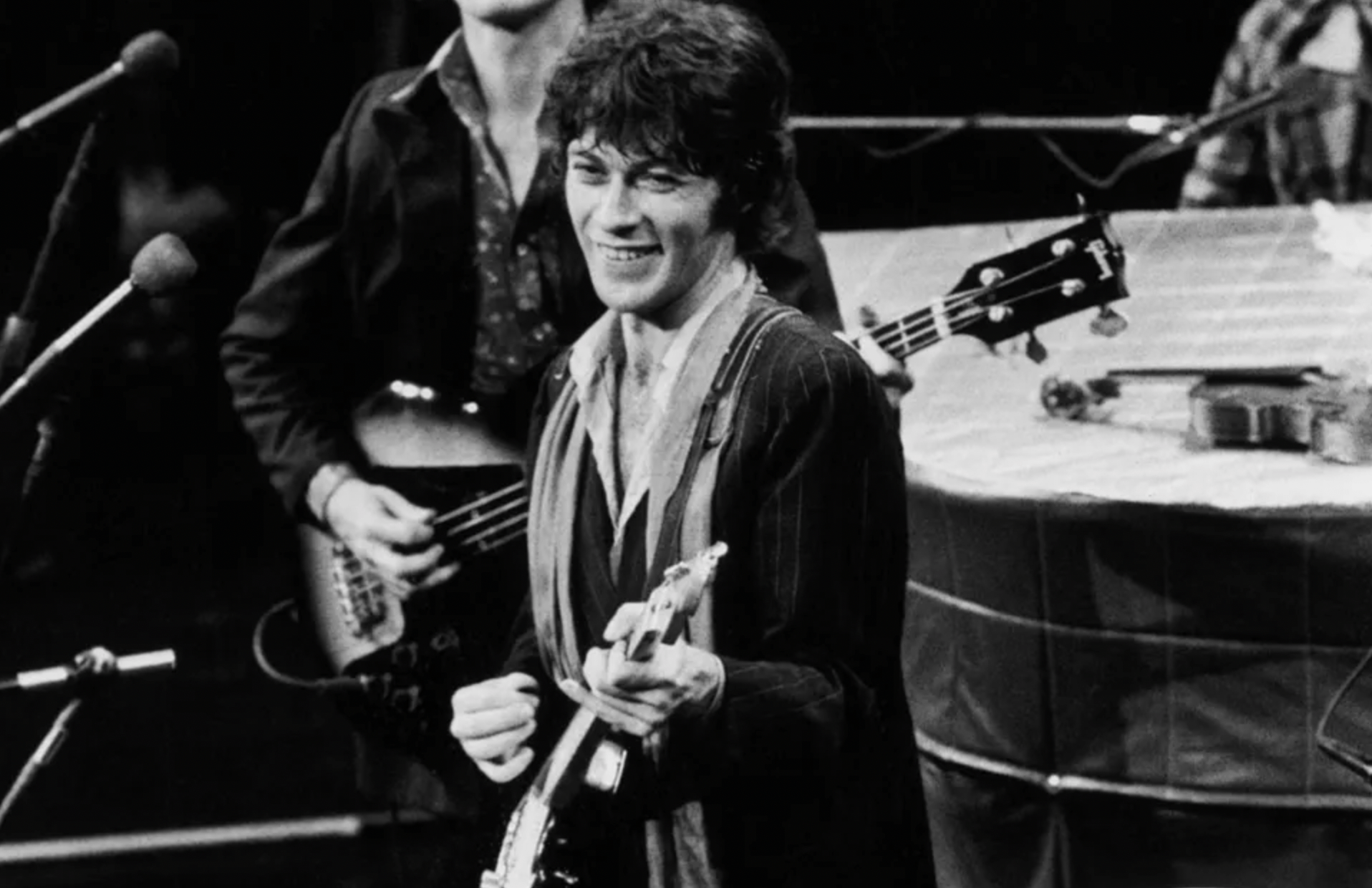
As the principal writer of the Band, Robbie Robertson crafted songs that became the equivalent of jazz standards for artists in rock, roots music and especially the genre-melding tradition known today as Americana — most notably “The Weight” and “The Night They Drove Old Dixie Down.”
Robertson settled into his roles as lead guitarist and songsmith naturally, yielding the vocal leads and even harmonies almost entirely to his bandmates. Quick — think of another all-time-great rock band whose main songwriter didn’t sing at all. (Part of the lore of the Band is that Robertson’s mic wasn’t on when he appeared to sing so prominently during The Last Waltz.) One big reason for this, beyond his own limitations as a vocalist, was that in the Band he was surrounded by three raw but gifted singers in Levon Helm, Richard Manuel and Rick Danko. Their soulful everyman qualities brought to life Robertson’s richly detailed and evocative lyrics.
As a guitarist, Robertson had the chops that were de rigueur for the era, but he was a shrewd, effective player who understood how a simple lick could define a song. He found inspiration in not only the music of the American South, but also in its history and culture, which can be vividly heard in songs like “King Harvest (Has Surely Come),” “Up on Cripple Creek” and “Rag Mama Rag.” His guitar sound was quintessentially Fender, with its trebly, biting riffs that never devolved into the overwrought guitar-hero soloing so popular at that time.
The irony of a Canadian-born artist like Robertson writing some of the most purely American (and Southern) songs in rock history has been pointed out over and over. But he wasn’t alone in this pursuit. Likewise inspired by the music and people of America, Neil Young, Joni Mitchell, Leonard Cohen and Gordon Lightfoot all came from the North and assimilated their vision with the essence of the U.S. in the ’60s and ’70s. Separating Robertson from that illustrious group was his unique First Nation roots. His mother was Cayuga and Mohawk and had been raised on a reservation outside Toronto. His father, who did not raise him, was Jewish. It wouldn’t be until later in his career that he would explore this rich heritage in his music.
It was rock ’n’ roll that truly shaped Robertson who, like so many young men in the ’50s and ’60s, picked up a guitar and honed his craft playing covers in bars. The rockabilly and rock ’n’ roll singer Ronnie Hawkins took the young guitarist under his wing, and it was as a member of the roadhouse-touring Hawks that Robertson would meet his future collaborators in the Band. In the Hawks they would struggle along as smalltime road dogs, until a mid-’60s stint backing Bob Dylan elevated their profile and made them a catalyst in Dylan’s earth-shattering transition from folkie to rock icon. In 1967, after Dylan had retreated from his career following his motorcycle accident, most of the Band relocated to a house with a pink exterior in West Saugerties, N.Y., near Woodstock (before Woodstock). It was there, where they adopted the moniker the Band, that they truly cultivated their group sound, seamlessly and intuitively mixing rock, folk, blues, country, R&B and bluegrass. Their resulting debut album, Music From Big Pink, released in 1968, was unlike anything heard during that groovy psychedelic era, and the Band went from cult favorites to critical darlings of worldwide acclaim. They also found themselves collaborating with Dylan during his period of respite upstate, at Dylan’s home and then at Big Pink, and those recordings can be found on the classic 1975 release The Basement Tapes.
If you were to make a movie about a rock band, or even a soul or R&B band, from the ’60s and ’70s, you could just as well take the Band’s story and simply change a few details and names and roll the cameras. Because it’s all there: The meet-cute of young men who traverse hardscrabble early years playing dives with a mercurial frontman before going off on their own to create their identity. Then an organic breakthrough period as the group seems to catch lightning in a bottle, followed by a rapid rise to fame that ends up taking its toll on the members, in varying ways. The inevitable break-up, seemingly amicable but eventually acrimonious, leaves the members to spin their own version of the halcyon days.
Of course they did make a movie about the Band. Martin Scorsese’s The Last Waltz, from 1978, which doubles as a documentary and concert film, is perhaps even more iconic than the group’s early albums, to the point where Rob Reiner did an obvious imitation of Scorcese as the inquiring filmmaker in the just-as-iconic This Is Spinal Tap.
The final performances in that film, filled with all-star cameos, included Bob Dylan, whose impact on the group’s music and success cannot go overstated. In fact, it’s hard to separate Robertson and Dylan, whose lives and music were so deeply entwined in the late ’60s, when Dylan was in recluse mode and in the midst of redefining himself. Looking back, it’s difficult to say who influenced the other more, though Dylan has always been able to move on to the next source of inspiration. But make no mistake: Robertson was an essential compadre and muse to Dylan, seeing him through the early days of brazen electric sets and on to the unfiltered brio of The Basement Tapes and the arena-roots-rock performances of the mid-’70s, well captured in Before the Flood.
I have to admit that I’ve always been a Levon Helm guy, whose downhome persona just seemed more relatable to me. He also carried the torch for the Band’s music and eventually created the Midnight Ramble in his home in Woodstock not far from Big Pink. Longtime fans of the Band seemingly had to choose sides when the two alphas of the group went through what looked like an ugly divorce — with the rest of the band resembling the children doing their best to bring it all back together. The basis for the disagreement would shift over the years, though the usual issue of songwriting credits and revenue was certainly in play. In the recent documentary Once Were Brothers, made after Helm’s death in 2012, Robertson pointed to the horrendous effect that substance abuse had on his bandmates back in the day — to the point where he felt his family wasn’t safe around his colleagues.
For his part, Robertson did what so many members of a renowned rock band have done: He moved on to a solo career, making music that often barely resembled what he’d created with the guys he came up with. While the other members continued along the rootsy path they’d built in those formative years, Robertson reinvented himself in Los Angeles. His post-Band output was more atmospheric and score-like, with rich orchestration and instrumentation far removed from those raw rock ’n’ roll days. He also explored his First Nation heritage in works like his 1987 song “Broken Arrow,” from his first solo record, and Music for ‘The Native Americans,’ released in 1994. Although his solo records had some commercial success and critical acclaim, none would resonate like his earlier material with the Band. Over the last 40-plus years, Robertson also kept active in film, serving as a composer, music supervisor, consultant and producer on numerous projects, often alongside Scorcese, including the director’s Raging Bull, The Irishman, The Wolf of Wall Street, Gangs of New York, Casino and Killers of the Flower Moon, for which Robertson composed the score.
Although he never reconciled with Helm, Robertson did rekindle his personal and professional relationships with Danko and Hudson, both of whom contributed to his solo recordings. He also paid tribute to Richard Manuel after the singer-pianist’s suicide in 1986, with the song “Fallen Angel.” (It’s somewhat ironic that the man who was seen as the elder in the Band, Garth Hudson, was the last one to pass on.)
Robertson’s voice will live on through unforgettable songs that have touched generations, and in those extraordinary Band LPs that opened rock to new cultural and historical possibilities. Just because you’re a Levon guy doesn’t mean you can’t be a Robbie guy, too. Like me.
Great piece Mr. Mergner, thank you. The diverging paths of Robertson and Helm are sort of two ways of being in the world, Robertson leaving a mark on the culture at large, while Helm deepened his roots. It’s their work together that gave them the lives they chose.