
Photo of Joe Block by Gilberto Tadday
The pianist Joe Block will be celebrating the release of There Is Always Hope, his third album as a leader, with shows featuring his quintet at Dizzy’s on Sep. 28. Recently released on Blue Engine, the album is a culmination of his varied experiences as both a student and working musician.
The Philadelphia-born and-bred Block credits his numerous teachers and mentors from that city as essential to his development as a jazz musician. Like many jazz pianists, Block started playing classical music at a young age, in his case studying with Susan Starr and Harvey Wedeen at the Settlement Music School when he was just a toddler. But when he was 13 years old, he became interested in improvising. “I started listening to Oscar Peterson, Charlie Parker and others,” he explains. “I was like, ‘Wow, I think I want to do this.’”
His parents took him to the Philadelphia Clef Club, a local community jazz education program and venue, where he fell under the influence of Lovett Hines, the longtime jazz and music teacher whose former students include Christian McBride, Joey DeFrancesco, Orrin Evans and many others. “That’s where it all started,” Block says. “There are people I play with today who I met 12 or 13 years ago there.”
Block also studied with the renowned bassist Anthony Tidd in the Creative Music program at the Kimmel Center, but it was his informal education on the bandstand at area venues like South and Chris’s Jazz Café that truly rounded out his jazz training. “I was able to be mentored by musicians like Mike Boone, Byron Landham and Larry McKenna who I played with and who I still get to play with,” he says. “I feel like I was exposed to such amazing education through the combination of studying in those programs and playing on the scene.”
Block says that those lessons from established band leaders in his hometown had an indelible impact on him as a young musician. “Ever since I was little, I really loved organizing, leading and arranging for big bands,” he says. “I actually had a big band in Philadelphia when I was in high school that I started with my friends. And we got to play all over the city through the Clef Club. Something I’ve always loved doing is musical directing and writing charts.”
Block says that attending a rigorous private school in Philadelphia also helped his transition to attending an Ivy League university in NYC. “Going to Germantown Friends for 12 years, I was very much used to being in a highly academic environment,” he explains. “So transitioning to a school like Columbia felt natural. And I think my parents really wanted me to continue with my education outside of music.” The pianist eventually enrolled in a dual program at Columbia and Juilliard taking classes on subjects like history and philosophy at the former and music theory and composition classes at the latter, as well as studying with Geoffrey Keezer, Marc Cary, Ted Rosenthal, and Frank Kimbrough. “I really like being in an academic environment,” he says. “I like the boundaries and the pressure that exist in that. And I think I thrive in those sorts of environments.” He graduated from the Columbia–Juilliard dual-degree program with both a Bachelor’s and Master’s in music.
Recipient of the 2024 ASCAP Herb Alpert Young Jazz Composer Award, Block was also a semi-finalist in the 2023 Herbie Hancock Institute of Jazz International Piano Competition, and was selected as a finalist for the 2027 American Piano Awards. Over the years, Wynton Marsalis gave him opportunities to do arrangements and musical direction for the JLCO. An early participant in Jazz at Lincoln Center programs like Essentially Ellington (EE) and the Summer Jazz Academy, Block initially came to Marsalis’ attention in 2016 when he won EE’s composition contest and wrote a chart for the JLCO. “That was before he even heard me play the piano,” he says. “He just knew me first as a composer. Then last week in Ireland, we were playing another one of my arrangements 12 years later. So that was a big moment for me.”
In addition to his work playing jazz with the JLCO (subbing in the piano chair) and various groups in both NYC and Philadelphia, Block was able to further exercise his writing and arranging chops as the associate music director and pianist for the Broadway production of Good Night, and Good Luck, produced by and starring George Clooney. “There was a live jazz band on stage,” he says. “They gave Bryan Carter [the music director] the green light to hire real jazz musicians who play jazz professionally instead of having to go through the Broadway scene. I basically had to stop doing gigs for about five months to do that because we had eight shows a week. But that was a great experience. I got to meet a lot of amazing people. I feel like I just dipped my foot into it, because I didn’t really dive into that world.”
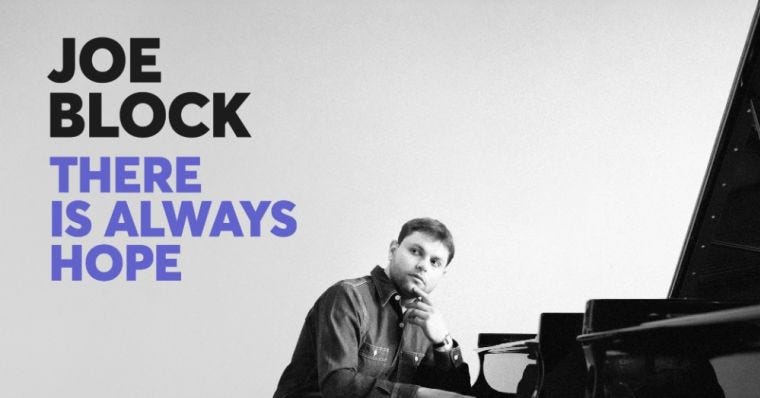
During the shows at Dizzy’s, Block will be performing material from There Is Always Hope, which was his first featuring both a small group and his original compositions. His first album was recorded with the vocalist Shabnam Abedi and his second was a solo piano record. “I think now I’m getting more used to recording,” he says. “When I first started, I was very nervous about the idea of playing something that would be permanent. As I’ve gotten older, I’ve learned that being able to play really well in a recording studio is a completely different skill set than being able to play live at Smalls or Dizzy’s or the Vanguard. So I’m really happy that I’ve gotten to record those other albums first. Also, something else that was great about this record was that we played at Smalls the week before we recorded and then we went to the studio. I was very adamant about not using booths or headphones. I wanted to capture the feeling of us playing live as much as possible. So we ended up just recording in one room. And it turned out great.”
Wherever his career path takes him, Block values his connection to Jazz at Lincoln Center. “I’m very grateful for all the opportunities I’ve gotten through them,” he explains. “Obviously, this album being a huge one. I hope to continue to have my foot in there as much as they would welcome me. However, I’ve also always been very conscious about doing other things too, because I’ve never been someone to only want to do one thing.”