Etienne Charles Explores the Folklore of the African Diaspora
The trumpeter and composer talks about his upcoming Folklore LIVE Vol. 2 show in the Appel Room at Jazz at Lincoln Center.

This is another piece written for the Jazz at Lincoln Center concert program.
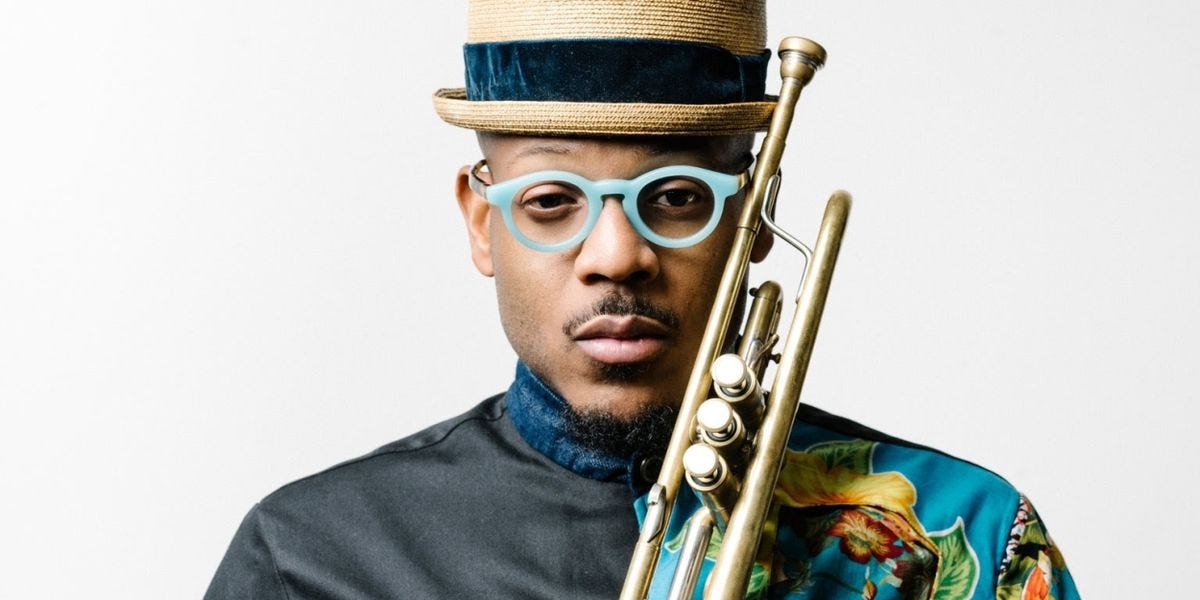
When most jazz artists travel, they’re likely to see little more than airports, hotels, and venues. But Etienne Charles travels to learn as well as perform.
The trumpeter’s upcoming Folklore LIVE Vol. 2 concerts June 5-6 will feature material that presents stories and characters from the African diaspora culled from his experiences in places like Haiti, Trinidad, South Carolina’s Lowcountry, and Mexico. With his Creole Soul band as well as special guests, Charles will return to the Appel Room to present music from his 2009 Folklore album as well as debuting more recent pieces.
In keeping with his peripatetic ways, many of the compositions were written on the move. “A lot of my main ideas come when I’m in motion,” he says. “So, if I have, say, a two- or three- or four-hour drive, I’ll use my phone to record some voice notes. Once I have the storyline of whatever the character or whatever it is that’s trying to be portrayed, then I’m able to turn it into something sonically. Piece by piece, after I go somewhere and I learn about different characters and different rituals, I’ll then sit down and write some music about it.”
The concerts will feature more than music, because he also integrates dance, masquerade, and spoken word into his compositions. “A lot of these characters are sort of a hybrid between a human and an animal,” Charles explains. “Or they might be like a complete character. For me, the only way to really bring it to life with performance is with a masquerade or with a dancer, because a lot of times there’s a particular type of movement that we only understand when we learn the story.”
The result is a fully immersive and colorful presentation that explores storytelling traditions that evolved from Africa to the New World. “It’s all about mystical characters and about bringing fantasies to life, because that’s what the African folklore storytelling traditions are about,” he says. “Creating these amazing creatures that some ancestor may have seen thousands of years ago.”
Throughout his recording career, Charles has delved into the music and culture from many different regions, evidenced by albums such as Carnival, Kaiso, Gullah Roots, San Jose Suite, and, of course, Folklore. In particular, his dedication to his native Trinidad and Tobago has been a central theme in his music. For many years, he’s formed and led Carnival bands there, with a live brass band playing vintage calypso and soca on a truck winding its way through the streets of Port of Spain. He’s also done community outreach through performances and workshops held throughout the country.
An Associate Professor of Studio Music and Jazz at the Patricia L. Frost School of Music at the University of Miami, Charles sees his concerts at Jazz at Lincoln Center as an educational opportunity.
“I want people to understand that this African diaspora is vast and that there are many different ways that we are connected,” he says. “One of the main common denominators that we have around the diaspora is this concept of storytelling that passes our traditions down from generation to generation. More than anything else, we have to keep that going, as technology keeps us from gathering. A lot of times the gathering was where the culture or these stories would be passed on. Live music is one of the few times now where people gather to experience something. I want people to have a good time and understand that we’re here together to experience a ritual that goes all across the African diaspora.”